Parking
Council regulates parking across City of Moreton Bay. This keeps our roads safe, accessible, and fair for all road users, while reducing congestion in busy town centres, school zones, and growing residential areas.
Drivers are encouraged to check local parking signs and must follow road rules.
Parking rules and regulations
The State Government sets parking rules under the Transport Operations (Road Use Management - Road Rules) Regulation 2009. These are enforced and regulated by Council’s Parking Local Law 2023. It is the driver's responsibility to know and comply with these rules.
Common parking and stopping rules
For more information about parking and road rules, visit the Department of Transport and Main Roads.
Vehicles must be parked on private property or the street with all tyres on the road surface. Failing to park safely and legally may:
- create a risk to pedestrian safety
- impact underground infrastructure
- block access to essential services
- reduce visibility
- cause significant damage to the verge.
Drivers should be aware of and abide by all parking and road rules. When parking, you must:
- leave at least 3 metres of clear roadway between your vehicle and any dividing lines or strips
- keep at least 3 metres of clear roadway between your vehicle and the opposite side of the street or any vehicles parked on the opposite side of the street
- park parallel to the road edge, facing the direction of travel.

An example of cars parked illegally, providing less than 3 metres of clear roadway.

An example of a car parked illegally, providing less than 3 metres of clear roadway.
Safe street parking
Footpaths, nature strips, dividing strips, painted islands and traffic islands are in place to help safe pedestrian movement along roadsides.
You must not stop or park:
- on footpaths, bike paths, nature strips or road reserves
- on dividing strips, painted islands or traffic islands
- in a way that makes it difficult for other drivers to exit a property or side road
- in a manner that could damage underground infrastructure.

An example of cars parked illegally on the road reserve/footpath.

An example of a car parked illegally with its boot overhanging a paved footpath.
Parking across driveways
You cannot park your vehicle across a driveway or near a driveway if it prevents access to a property. You can stop across a driveway for up to two minutes to pick up or set down passengers. However, you must ensure your vehicle does not block or hinder anyone from accessing the driveway during this time.

An example of a car parked illegally across a driveway.

An example of a car parked illegally between two driveways, restricting access.
Stopping or parking in or near an intersection
An intersection is where two or more roads meet, or where vehicles on different roads may collide. You must not stop or park less than:
- 10 metres from an intersection without traffic lights
- 20 metres from an intersection with traffic lights.
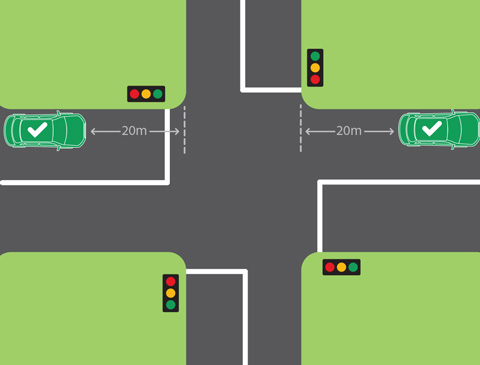
An example of cars parked legally at an intersection with traffic lights.
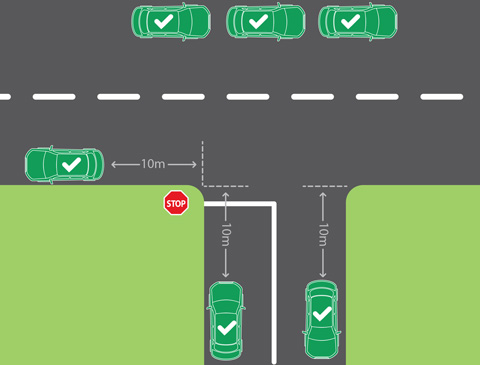
An example of cars parked legally at an intersection without traffic lights.
Stopping or parking on an unsealed road shoulder
You can park your vehicle on an unsealed road shoulder. However, your vehicle must be parallel to the road and facing the direction of travel.
You cannot park on a road shoulder if there is a no stopping sign or a continuous yellow line.
No stopping sign
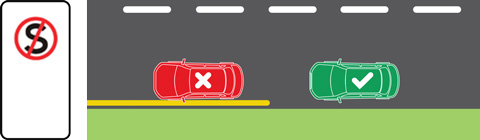
An example of a no stopping sign, and a car parked illegally next to a continuous yellow line.
No parking sign
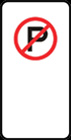
An example of a no parking sign.
Parking heavy or long vehicles in built-up areas
A built-up area is a road where, for at least 500 meters (or the entire road if shorter), there are either buildings or streetlights spaced no more than 100 meters apart.
You cannot park or stop a heavy or long vehicle in a built-up area for longer than one hour unless you are engaged in dropping off or picking up goods for the entire time the vehicle is stopped.
A heavy vehicle is a vehicle with a gross vehicle mass (GVM) of 4.5 tonnes or more. A long vehicle is a vehicle with a length of 7.5 metres or more. This length includes vehicles with a boat, trailer or caravan attached.
An example of a heavy and long vehicle (a truck) parked on a residential street.

An example of a long vehicle (a ute and boat exceeding 7.5 metres) parked on a residential street.
Report illegal parking
If a vehicle is parked illegally in City of Moreton Bay, you can report it online to Council.
Report an illegally parked vehicle
You can also report illegal parking through the Snap Send Solve app.