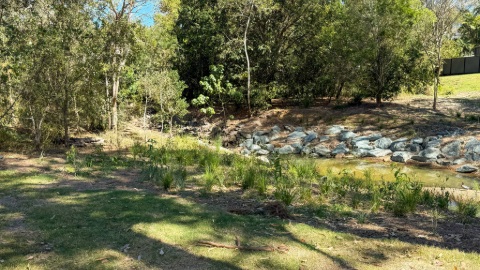
City of Moreton Bay is rehabilitating Freshwater Creek at Freshwater Reserve, Balstrup Park and John Mott Reserve in Kallangur.
At Freshwater Reserve, this work includes removing invasive weed species and restoring native vegetation across a 4.23-hectare area. The team will plant more than 19,000 plants.
They have also removed understorey weeds at John Mott Reserve and will replant 8000 native plants.
This work is part of a larger project to strengthen an important wildlife corridor between reserves.
The team has removed invasive species, such as camphor laurel and broad-leafed pepper tree. These trees' dense canopies and root systems prevent native seeds from germinating and destabilise creek banks. Their leaves contain toxic elements that can break down in water and harm ecosystems.
Native species will replace invasive plants. This creates wildlife habitat and improves the health of Freshwater Creek.
Both projects are planned and delivered by environmental experts. They aim to revitalise native characteristics to better reflect the surrounding natural environment. This brings natural resilience to the ecosystem as well as aesthetic benefits.
Tree planting and benefits
Council is planting more than 27,000 plants, including:
- blue gum
- swamp box
- pink bloodwood
- cheese trees.
Smaller plants along the bank will support wildlife and help stabilise the creek against erosion.
These native trees will provide:
- shade for reserve visitors
- habitat and food for native wildlife.
The project follows similar successful work in nearby Ross Reserve.
Wildlife in Freshwater Creek Reserve
Restoring native vegetation will improve wildlife habitat, strengthen wildlife corridors and reintroduce the native seed bank to promote natural regeneration.
Areas of the creek embankment are steep, eroded and without native vegetation. Work to stabilise and replant along the banks will improve habitat for a range of species, including:
- koalas
- grey-headed flying foxes
- marsupial mice
- water rats (rakali)
- woodland birds
- waterbirds.
The reserve contains Core Koala Habitat and is a Koala Priority Area. The reserve is home to platypus and provides a 460 metre wildlife corridor link between Balstrup Park and Ross Reserve.
The team has recorded Platypus downstream of the project site. The project aims to restore platypus habitat and encourage habitat expansion.
Construction times
Works commenced in January 2026 and are expected to be completed in mid-2027.
During this time, the environmental team will typically be on site between the hours of 7:00 am and 4:00 pm, Monday to Friday.
There will be minimal impact to park visitors during the restoration works.
Funding
The Freshwater Creek Rehabilitation Project is funded through Resilient Rivers South East Queensland (RRSEQ) under the SEQ City Deal, a partnership between the Australian Government, Queensland Government and Council of Mayors (SEQ). The program delivers coordinated catchment management across South East Queensland.
Learn more about RRSEQ partnerships.